
October 4, 2026
Major Fields of Psychology Explained
Psychology is often described simply as the study of the mind and behavior, but the field is much broader than that definition suggests. Psychologists study everything from memory and learning to relationships, child development, workplace behavior, physical health, and mental disorders. Because human behavior is so complex, psychology has developed into several specialized fields, each focusing on different questions and real-world problems.
For example, one psychologist might help a person manage symptoms of a mental health condition, while another may study how children develop language skills. A psychologist working in a company might examine employee motivation, whereas a researcher may investigate how memory influences decision-making.
Understanding the major fields of psychology can therefore help students, aspiring professionals, and anyone interested in human behavior understand what psychologists actually do. It can also make it easier to identify which area of psychology best matches a particular interest or career goal.

1. Psychology Fields Focused on the Individual and Human Development
Clinical Psychology
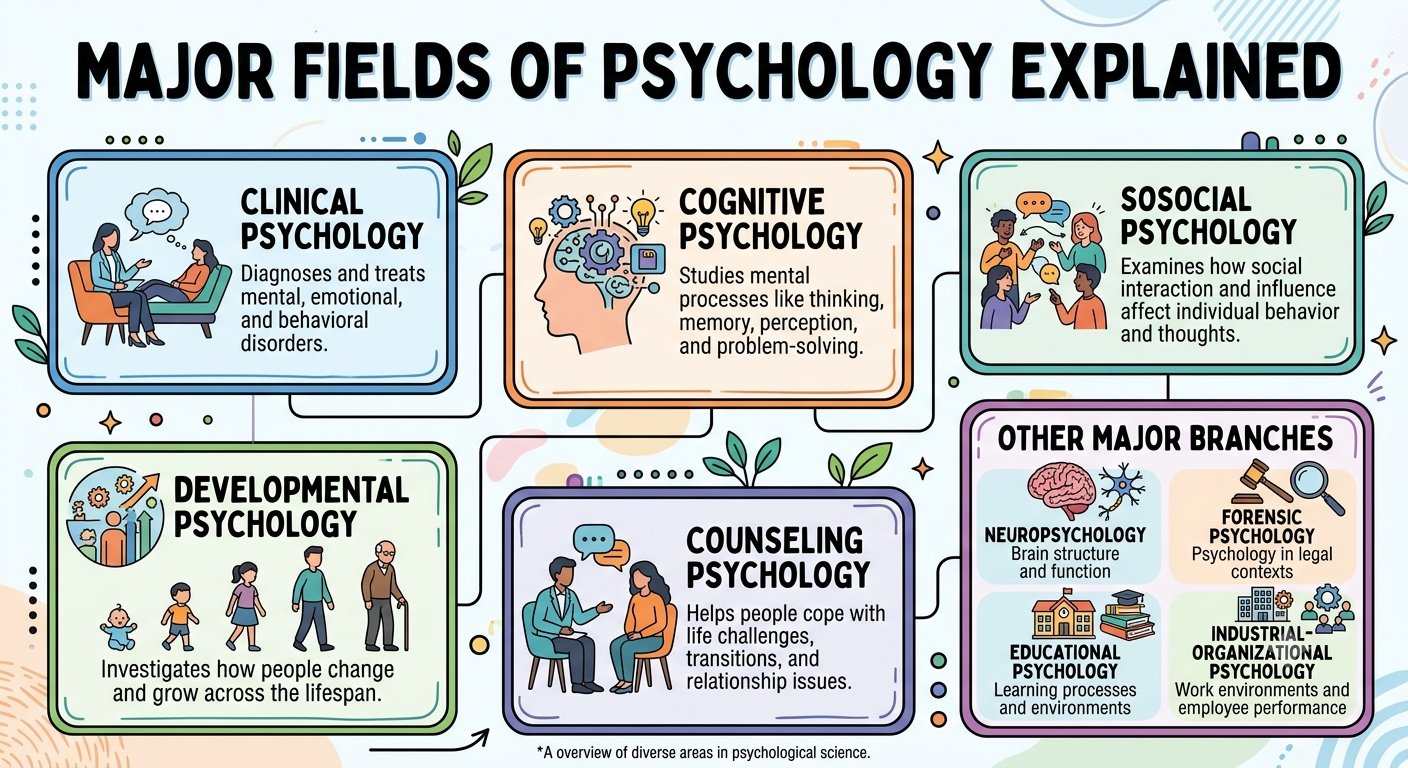
Clinical Psychology is one of the most widely recognized areas of psychology. It focuses on understanding, assessing, and treating psychological and behavioral difficulties. Clinical psychologists may work with individuals experiencing conditions such as anxiety, depression, trauma-related difficulties, or other psychological disorders.
Their work can take place in hospitals, clinics, mental health centers, universities, research settings, and private practices, depending on their training and professional qualifications.
Clinical psychology is not limited to treatment, however. Clinical psychologists may also conduct psychological assessments, carry out research, develop interventions, and contribute to mental health programs.
Counseling Psychology
Counseling Psychology shares some similarities with clinical psychology but often has a broader emphasis on emotional wellbeing, adjustment, life challenges, and personal development. Counseling psychologists may help people cope with relationship difficulties, academic pressure, career decisions, stress, grief, or major life transitions.
A useful way to think about the distinction is that clinical psychology traditionally has a stronger focus on psychological disorders, while counseling psychology often places greater emphasis on everyday adjustment and wellbeing. In practice, the boundaries between the two fields can overlap.
Developmental Psychology
Developmental Psychology examines how people change throughout their lives. Although early childhood development is an important area of research, developmental psychologists can study changes from infancy through adolescence, adulthood, and later life.
Researchers may explore cognitive development, emotional development, language, social relationships, identity, and aging.
Consider a simple example: a child learning to understand other people’s emotions involves developmental processes that change considerably with age. A developmental psychologist might investigate when particular abilities emerge and what environmental or biological factors influence them.
2. Psychology Fields That Explain Thinking, Learning, and Behavior
Cognitive Psychology
Cognitive Psychology focuses on mental processes such as attention, memory, perception, language, problem-solving, and decision-making.
Much of everyday life involves cognitive processes. Remembering where you left your phone, concentrating during a lecture, choosing between two options, or trying to understand a difficult concept all involve cognition.
Cognitive psychologists investigate questions such as: Why do we forget information? How does attention affect learning? Why do people sometimes make predictable thinking errors? Their research has applications in education, technology, healthcare, human-computer interaction, and many other areas.
Behavioral Psychology
Behavioral Psychology focuses on observable behavior and the ways learning and environmental factors influence it. It is strongly associated with principles such as conditioning, reinforcement, punishment, and behavioral learning.
For instance, imagine a student who starts studying regularly after receiving positive feedback for completing assignments. A behavioral perspective would examine how consequences and environmental cues may influence the continuation of that behavior.
Behavioral principles are applied in areas such as education, mental health interventions, parenting programs, organizational settings, and behavior-change initiatives.
Social Psychology
While cognitive psychology examines processes occurring within the individual, Social Psychology looks closely at how other people and social environments influence thoughts, feelings, and behavior.
Social psychologists study topics such as conformity, persuasion, prejudice, stereotypes, group behavior, interpersonal relationships, social identity, and social influence.
Think about how differently people may behave when answering a question alone compared with answering it in front of a large group. Social psychology helps explain how the presence, expectations, and opinions of others can influence individual behavior.
This field is particularly useful for understanding everyday interactions, from friendships and relationships to workplace dynamics and online social behavior.
3. Psychology Applied to Education, Health, Work, and Law
Educational Psychology
Educational Psychology applies psychological principles to learning and teaching. It explores how students acquire knowledge, how motivation influences academic performance, how people learn differently, and how educational environments can support development.
Educational psychologists may study learning difficulties, classroom behavior, assessment, motivation, memory, and teaching strategies.
For example, understanding how attention and memory work can help educators design learning experiences that make information easier to understand and retain.
Health Psychology
Health Psychology examines the relationship between psychological factors, behavior, and physical health. It recognizes that health is influenced by more than biological processes alone.
Health psychologists may study topics such as health behaviors, stress, coping, adherence to treatment, chronic illness, pain management, and lifestyle changes.
Consider someone who knows that regular physical activity is beneficial but struggles to maintain the habit. A health psychology perspective might explore motivation, beliefs about health, environmental barriers, stress, and behavioral patterns that influence their choices.
This makes health psychology particularly relevant to modern healthcare, where prevention and long-term behavior change are increasingly important.
Industrial-Organizational Psychology
Industrial-Organizational Psychology, often shortened to I-O psychology, applies psychological principles to workplaces and organizations.
An I-O psychologist may study employee motivation, job satisfaction, leadership, teamwork, workplace communication, recruitment, performance assessment, training, and organizational culture.
For example, if a company notices that employees are leaving at a high rate, an I-O psychologist might investigate factors such as job satisfaction, management practices, workload, workplace relationships, and organizational climate.
This field demonstrates that psychology extends well beyond hospitals and therapy rooms. Understanding human behavior can also help organizations create healthier and more effective workplaces.
Forensic Psychology
Forensic Psychology involves the application of psychological knowledge to legal and criminal justice settings. It can involve areas such as psychological assessment, criminal behavior, eyewitness testimony, risk assessment, and issues involving courts and legal decision-making.
Forensic psychologists may work in correctional settings, courts, mental health facilities, research institutions, or other environments connected with the legal system, depending on their professional training and jurisdiction.
The field is often portrayed dramatically in movies and television, but real forensic psychology involves careful assessment, research, ethical standards, and evidence-based psychological knowledge rather than simply “profiling criminals.”
4. How These Fields Connect With One Another
Although psychology is divided into different specialties, these fields are not isolated from one another. Human behavior rarely fits neatly into a single category.
Consider a college student experiencing academic difficulties. A cognitive psychologist might examine attention and memory. An educational psychologist could investigate learning strategies and academic motivation. A counseling psychologist might explore stress or adjustment difficulties, while a social psychologist could consider the student’s relationships and social environment.
Similarly, workplace wellbeing can involve several perspectives. Industrial-organizational psychology may examine organizational culture, health psychology may consider stress and health behaviors, and social psychology may help explain communication and group dynamics.
This overlap is one of the reasons psychology is such a diverse discipline. The same human behavior can often be understood from several psychological perspectives.
5. How to Choose a Field of Psychology
For psychology students, choosing a specialization can feel overwhelming because there are so many possibilities. A useful starting point is to ask what kinds of questions naturally interest you.
If you are interested in mental health assessment and psychological disorders, Clinical Psychology may be worth exploring. If you enjoy understanding relationships, groups, and social influence, Social Psychology could be a better fit.
Students fascinated by memory, attention, and decision-making may enjoy Cognitive Psychology, while those interested in children, aging, or changes across the lifespan may prefer Developmental Psychology.
If you are interested in education and learning, consider Educational Psychology. If health behavior and the connection between mind and physical health appeal to you, Health Psychology may be a good direction.
For people interested in organizations and workplace behavior, Industrial-Organizational Psychology offers a particularly different career path. Those fascinated by law and criminal justice may want to explore Forensic Psychology.
It is also important to remember that learning about a field does not necessarily mean committing to it immediately. Psychology students can gain exposure through coursework, research projects, internships, volunteering, and reading research from different specialties.
Conclusion : Major Fields of Psychology Explained
The major fields of psychology demonstrate just how broad the study of human behavior really is. Clinical Psychology and Counseling Psychology focus strongly on psychological wellbeing and helping individuals, while Cognitive Psychology, Behavioral Psychology, and Social Psychology help explain how people think, learn, and interact.
At the same time, Developmental Psychology explores change across the lifespan, while Educational Psychology, Health Psychology, Industrial-Organizational Psychology, and Forensic Psychology apply psychological knowledge to education, healthcare, workplaces, and legal settings.
There is no single “best” field of psychology. The right area depends on the questions you want to explore, the people you want to work with, and the kind of impact you hope to make.
If you are a psychology student, start by exploring several fields rather than trying to choose immediately. Read about them, look at research, talk to professionals, and gain practical exposure where possible. You may discover that the area that interests you most is not the one you initially expected.
FOLLOW INSTAGRAM @psychwithtejal
If you’re exploring psychology as a subject and want to learn more about different areas, visit my Psychology Portfolio for more psychology-related work and resources.