August 16, 2026
Stress vs. Burnout: What’s the Difference and How to Tell?
Learn the difference between normal stress and burnout, including key symptoms, causes, recovery, and when ongoing stress may need professional support.
Stress is something almost everyone experiences. A difficult exam, an approaching deadline, a demanding workday, or a conflict with someone close to you can all create temporary pressure. In many situations, that pressure settles once the challenge passes or you have time to recover.
But what happens when the pressure doesn’t seem to switch off?
You may find yourself constantly tired, disconnected from things you once enjoyed, unable to concentrate, or struggling to feel motivated even after getting some rest. This is where the difference between stress vs. burnout becomes important.
Stress and burnout can overlap, but they are not exactly the same experience. Stress is generally a response to challenging circumstances, while burnout is associated with prolonged, unsuccessfully managed workplace stress. The World Health Organization (WHO) describes burnout in ICD-11 as an occupational phenomenon characterized by exhaustion, increased mental distance or cynicism toward one’s job, and reduced professional efficacy. (World Health Organization)
Understanding that distinction can help you recognize when you simply need recovery from a stressful period and when ongoing difficulties may deserve greater attention.
What Is Normal Stress?
Stress is the body’s natural response to challenging or demanding situations. It can happen when you have an important presentation tomorrow, several assignments due at once, or a difficult conversation coming up.
A short-term stress response can actually help you respond to a challenge. You might become more alert, focused, and motivated to finish a task. WHO describes stress as a natural human response to difficult situations and notes that some stress can help us perform everyday activities. (World Health Organization)
For example, imagine a student who has an important examination next week. They may feel nervous, have trouble relaxing in the evening, and spend more time studying than usual. Once the exam is over, they may sleep better, return to their normal routine, and feel like themselves again.
That’s an important feature of ordinary stress: the situation changes, and your ability to recover generally returns with it.
Stress can affect both the mind and body. Common experiences include irritability, difficulty concentrating, headaches, body aches, stomach discomfort, and problems sleeping. (World Health Organization)
The problem arises when stress becomes persistent and difficult to manage.
When Stress Becomes Chronic
Not every stressful period is burnout. However, chronic unmanaged stress can gradually affect your emotional and physical well-being.
Think about someone who has been dealing with unrealistic workloads for months. At first, they may simply feel busy. They work longer hours, rush through meals, postpone breaks, and tell themselves that things will become easier after the next deadline.
Then another deadline arrives.
And another.
Eventually, the person may notice that they are tired before the workday even begins. Concentrating takes more effort. Small problems feel disproportionately frustrating. Activities outside work may stop feeling enjoyable.
This is different from experiencing stress before one particularly difficult week.
Chronic stress can interfere with sleep, concentration, mood, and everyday functioning. WHO notes that persistent stress can contribute to physical and mental health problems and may affect functioning at work or school. (World Health Organization)
This doesn’t mean that everyone experiencing prolonged stress has burnout. It does mean that persistent stress deserves attention rather than being treated as something you simply have to push through.
The Key Signs of Burnout
Burnout has a more specific pattern. According to WHO, it is specifically related to chronic workplace stress that has not been successfully managed. Its three central dimensions are exhaustion, increased mental distance or cynicism toward one’s job, and reduced professional efficacy. (World Health Organization)
1. Emotional Exhaustion
One of the most recognizable features is emotional exhaustion.
This can feel different from simply being tired after a long day. Instead, you may feel as though your emotional and mental resources have been repeatedly drained.
For example, a person might think:
“I know I have things to do, but I don’t have anything left to give.”
Rest may provide temporary relief, but the feeling can return when they face the same work environment or demands.
2. Cynicism and Detachment
Another important distinction is cynicism and detachment.
Someone who previously cared about their work may gradually become emotionally distant from it. They may become unusually negative, detached, or cynical about their responsibilities, colleagues, or workplace.
This doesn’t necessarily mean that the person has become lazy or doesn’t care about their career. Emotional distancing can be a response to prolonged strain.
WHO identifies increased mental distance from one’s job and feelings of negativism or cynicism related to one’s job as one of burnout’s defining dimensions. (World Health Organization)
3. Reduced Effectiveness
Burnout can also involve reduced effectiveness.
Tasks that once felt manageable may begin to feel overwhelming. Productivity may decline, mistakes may increase, and completing ordinary responsibilities can require considerably more effort.
Someone might spend an entire afternoon working but feel that very little was actually accomplished.
This is why burnout isn’t simply equivalent to “being tired.” It can affect how effectively a person functions in their professional role.
4. Loss of Motivation and Enjoyment
Another experience people may notice is a loss of motivation and enjoyment.
Things that previously felt rewarding can start to feel like obligations. A person might stop looking forward to their work, hobbies, social activities, or other parts of their routine.
However, it’s important not to automatically label every period of low motivation as burnout. Similar experiences can occur for many different reasons, and persistent changes in mood or functioning may warrant discussion with a qualified health professional.
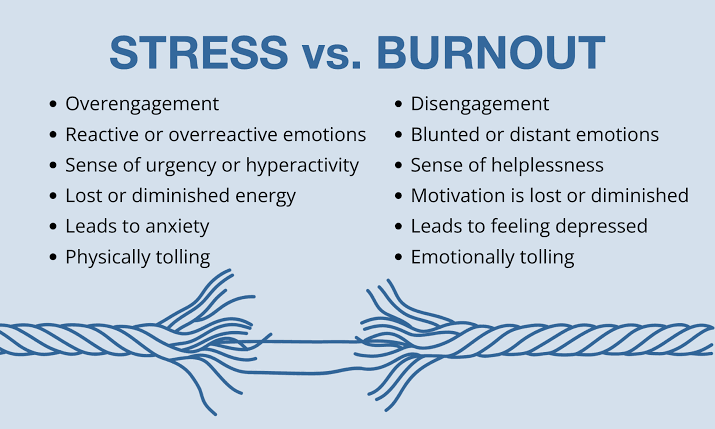
Stress vs. Burnout: What’s the Difference?
The simplest way to understand stress vs. burnout is to look at the overall pattern rather than one isolated symptom.
| Normal or Short-Term Stress | Burnout |
|---|---|
| Often linked to a specific challenge | Associated with prolonged, unsuccessfully managed workplace stress |
| You may feel overwhelmed but still engaged | You may become emotionally distant or cynical |
| Motivation may remain, even if you’re tired | Motivation and engagement may decline |
| Symptoms may improve when the stressor ends | Recovery may be more difficult when the stressful work conditions continue |
| Rest and time away may help you recover | Addressing ongoing workplace conditions may also be important |
| Performance may temporarily fluctuate | Professional effectiveness may decline |
This distinction is consistent with the WHO’s definition of burnout, which focuses on workplace stress and the combination of exhaustion, mental distance or cynicism, and reduced professional efficacy. (World Health Organization)
One useful question is:
“When I get a genuine opportunity to rest, do I feel like I am gradually returning to myself?”
If the answer is yes, you may be dealing with a stressful period that requires better recovery and stress management.
If you continue feeling depleted, detached, and ineffective while the same workplace pressures remain, it may be worth taking a closer look at what is happening.
What Recovery Can Look Like
For ordinary stress, recovery with rest can make a meaningful difference. Sleep, regular meals, physical activity, time away from demanding tasks, social connection, and enjoyable activities can all support recovery.
WHO recommends practical stress-management strategies alongside maintaining routines, getting enough sleep, exercising, and making time for recreation and supportive relationships. (World Health Organization)
But burnout usually cannot be addressed simply by telling someone to “take a weekend off.”
If the underlying workplace conditions remain unchanged—such as excessive workload, long hours, insufficient support, limited control, or unrealistic demands—the source of the strain may continue. WHO identifies factors such as time pressure, lack of control, long working hours, shift work, and lack of support as psychosocial risks associated with occupational stress and burnout. (World Health Organization)
That means meaningful recovery may involve looking at both the individual and the environment.
For example, someone might benefit from:
- Setting realistic boundaries around work.
- Taking regular breaks rather than working continuously.
- Discussing workload concerns with an appropriate supervisor.
- Using available workplace support.
- Protecting time for sleep and recovery.
- Reconnecting with activities outside work.
- Speaking with a qualified mental health or healthcare professional when difficulties persist.
It’s also important to remember that burnout is not the only explanation for exhaustion, low motivation, concentration difficulties, or changes in mood. These experiences can overlap with other mental or physical health concerns, so persistent or severe symptoms should not be self-diagnosed as burnout.
When Should You Take Your Symptoms Seriously?
Everyone has stressful days. Feeling tired after completing a demanding project doesn’t automatically mean you’re burned out.
The bigger question is whether the pattern is persistent, affecting your functioning, and connected to ongoing demands.
Pay particular attention if you notice ongoing difficulty concentrating and decision-making, persistent exhaustion, increasing detachment from work, declining effectiveness, or a significant change in your ability to enjoy everyday activities.
You should also take physical symptoms seriously. Physical symptoms of stress and burnout can include sleep difficulties, headaches, body discomfort, stomach problems, and other stress-related changes. WHO notes that stress can affect both physical and mental well-being. (World Health Organization)
Rather than trying to diagnose yourself from a checklist, consider the pattern and how much it is interfering with your daily life. If you’re struggling to function or your symptoms are persistent, speaking with a qualified healthcare or mental health professional can help you understand what may be happening.
Conclusion: Stress or Burnout?
The difference between normal stress and burnout isn’t simply about how tired you feel.
Normal stress is often a response to a specific challenge and may improve when the situation changes or when you have enough opportunity to recover. Burnout, in contrast, is defined by WHO specifically in relation to chronic workplace stress and involves exhaustion, mental distance or cynicism toward work, and reduced professional efficacy. (World Health Organization)
Understanding stress vs. burnout can help you recognize when you need a little more rest and when it’s time to look more closely at the conditions contributing to your distress.
If you’re writing or reading about mental well-being, remember that the goal isn’t to label every difficult period. It’s to notice patterns, take your well-being seriously, and seek appropriate support when you need it.
Your stress is worth paying attention to before it becomes something you simply learn to live with.
Follow on Instagram
Want to know my story and what I do? → Get to Know Me